
Table of Contents
Games at home · Researched September 30, 2026
The difficult part of fitting table tennis into a shared room often happens after the last game. The table may open beautifully, then block a cupboard when folded. A conversion top may save floor space while creating two large panels that somebody has to lift and put away.
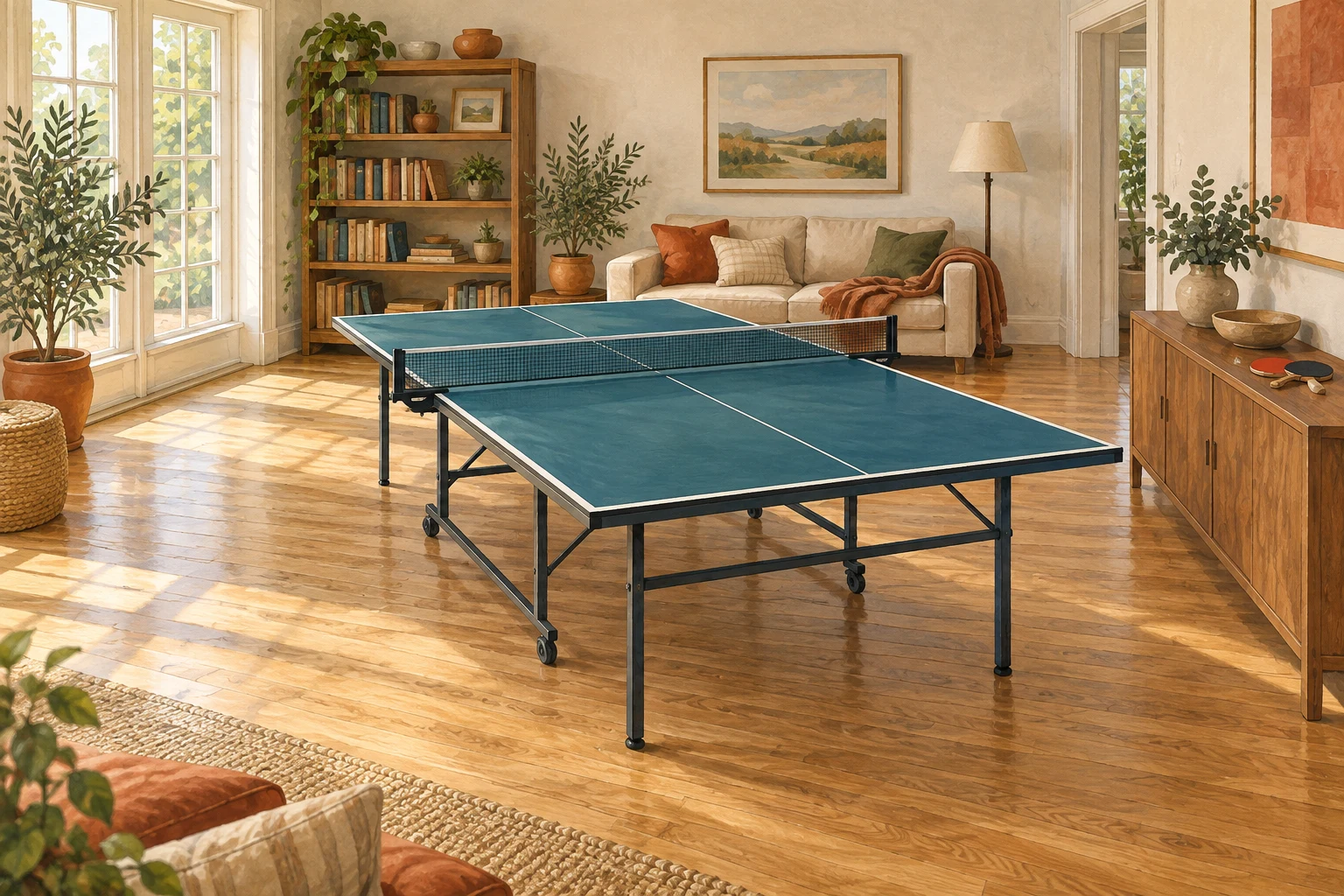
Before choosing a format, draw the room three times: while people play, while the table is stored and while it is being moved between those states. A product that works in all three drawings has a better chance of becoming part of the household routine.
Measure a place to play, not just a place for the table
A full-size playing surface is nominally 9 by 5 feet, with a height of about 30 inches. STIGA’s table-size guide gives the metric dimensions as 274 by 152.5 by 76 centimeters. Those are table dimensions. They do not describe the room needed for players, swings, movement or the net’s projections.
Mark the table outline on your room plan, then add the space you intend to leave at both ends and sides. A close-to-the-table family game and practice involving larger movements put different demands on the room. Do not let a calculator’s example allowances turn into a claim that a particular room is safe or suitable.
Table-tennis room planning calculator
All measurements are in feet. Enter the table dimensions and your own movement allowances. The defaults are an arithmetic example, not recommended minimum clearances.
This tool adds no tracking and does not send or save your entries. It runs in your browser; the worked example remains readable without JavaScript.
The default example adds three feet at each end and two at each side of a 9-by-5-foot surface, producing a 15-by-9-foot rectangle. Those allowances are illustrative, not recommended minimum clearances. Change them to examine your plan, then assess real player movement, the exact table and the room’s hazards. Doors, furniture, radiators, ceiling lights and routes through the room are not accounted for by a rectangle.
If the plan leaves no practical room to play, a compact table can be a more useful choice than a full-size surface squeezed between obstacles. It changes the game’s geometry, so choose it for the experience you want at home rather than assuming it recreates full-size practice.
A conversion top saves a second base, not the entire storage problem
A conversion top can be attractive when a suitable pool or other support table already occupies the room. You reuse that footprint instead of adding another set of legs. But the top needs appropriate support, protection for the surface underneath and a storage place for every panel when the original table is in use.
Start with the conversion top’s exact manual. Check which supporting tables it is designed for, the required contact areas, pads, overhang and net-clamp arrangement. A dining table should not be assumed suitable simply because its outline fits beneath the top. Its strength, stability, finish and height all matter to the resulting setup.
The manufacturer-linked JOOLA 11009 conversion-top manual, for example, flags heavy handling that may require two people. It is a useful reminder to read the handling instructions before buying, not a basis for assuming every JOOLA top shares the same dimensions or setup. JOOLA lists separate manuals for different tops on its instructions page.
Decide who will remove the panels and where they will stand while doing it. Follow the specified storage method; a narrow gap behind a sofa is not automatically an approved way to secure a heavy panel. If putting the top away requires a second person who is rarely available, that inconvenience belongs in the buying decision.
A folding table needs a parking space and a route to it
A freestanding folding table gives the playing surface its own support. Depending on the model, that may reduce the need to lift loose panels, but it does not remove the changeover task. Inspect the folded dimensions, moving procedure, wheel arrangement and locking instructions for the exact table.
Draw its stored outline where it will actually park. Then draw the route from there to the playing position. Measure door openings and awkward turns, and check whether thresholds or floor changes interfere with the manufacturer’s moving instructions. Leave access to cupboards and household equipment that you need between games.
Delivery deserves a separate pass. The packaged dimensions and component weights may determine whether the table can reach the room at all. “Fits when folded” does not answer whether the delivery carton passes through the stairwell or whether there is enough room to assemble it. Confirm the delivery service and your own handling arrangements before ordering.
A compact table can solve the right problem
Compact freestanding tables occupy a middle ground between a full-size table and a small tabletop game. The STIGA Space Saver illustrates the format with separate halves and folding legs. We are using it as a format example, not ranking its bounce, durability or value from hands-on testing.
Small does not mean effortless to handle. The associated T8460W/F manual calls for at least two adults to put the table together and specifies dry indoor storage. It also explains that humidity and temperature changes can affect the wood playing surface. Read “ready to play” marketing alongside the manual, particularly if one person will manage the room.
A compact surface makes sense when the household wants an accessible game and accepts different dimensions. It is less convincing if the main goal is to reproduce full-size practice. An indoor model also needs the storage conditions its manufacturer specifies; an unconditioned garage is not automatically equivalent to a dry room.
Compare the three states before comparing prices

| Format | While playing | Between games | Changeover question |
|---|---|---|---|
| Conversion top | Check the resulting height, support and player space. | Provide manufacturer-appropriate storage for panels, net and accessories. | Who lifts the pieces, and where can they move without obstruction? |
| Full-size folding table | Plan beyond the 9-by-5-foot surface. | Measure the entire folded assembly, including its base. | Can it reach its parking place using the specified moving procedure? |
| Compact freestanding table | Use the actual playing dimensions; expect a different game. | Check how the halves or legs fold and how they must be secured. | Can the intended users handle setup and storage as instructed? |
One final rehearsal can expose the inconvenience that measurements miss. Without buying anything, move the furniture that would have to move, open the necessary doors and mark where the stored table would sit. Time the room rearrangement. This does not validate table assembly or player clearance, but it tells you whether converting the room feels reasonable for a short weekday game.
If a conversion top still fits the plan, browse table-tennis conversion tops and check the exact manual before choosing. The tabletop table-tennis collection offers another format to investigate for occasional play; its listings should not be treated as interchangeable with freestanding tables. If you are uncertain how often the room will become a games room, use our borrow, rent or buy framework before committing.
The right choice is the one you can play on, put away and bring out again without turning a short game into a household project. Give all three stages a place in the room plan.
