
Table of Contents
Gear decisions · Researched September 30, 2026
A tent that leaves the closet twice a year can be worth owning. A paddleboard used every month can still be awkward to own if you cannot dry or transport it. Frequency matters, but it is only one part of the decision. The better question is which way of getting the equipment will make your next outing easiest to carry through.
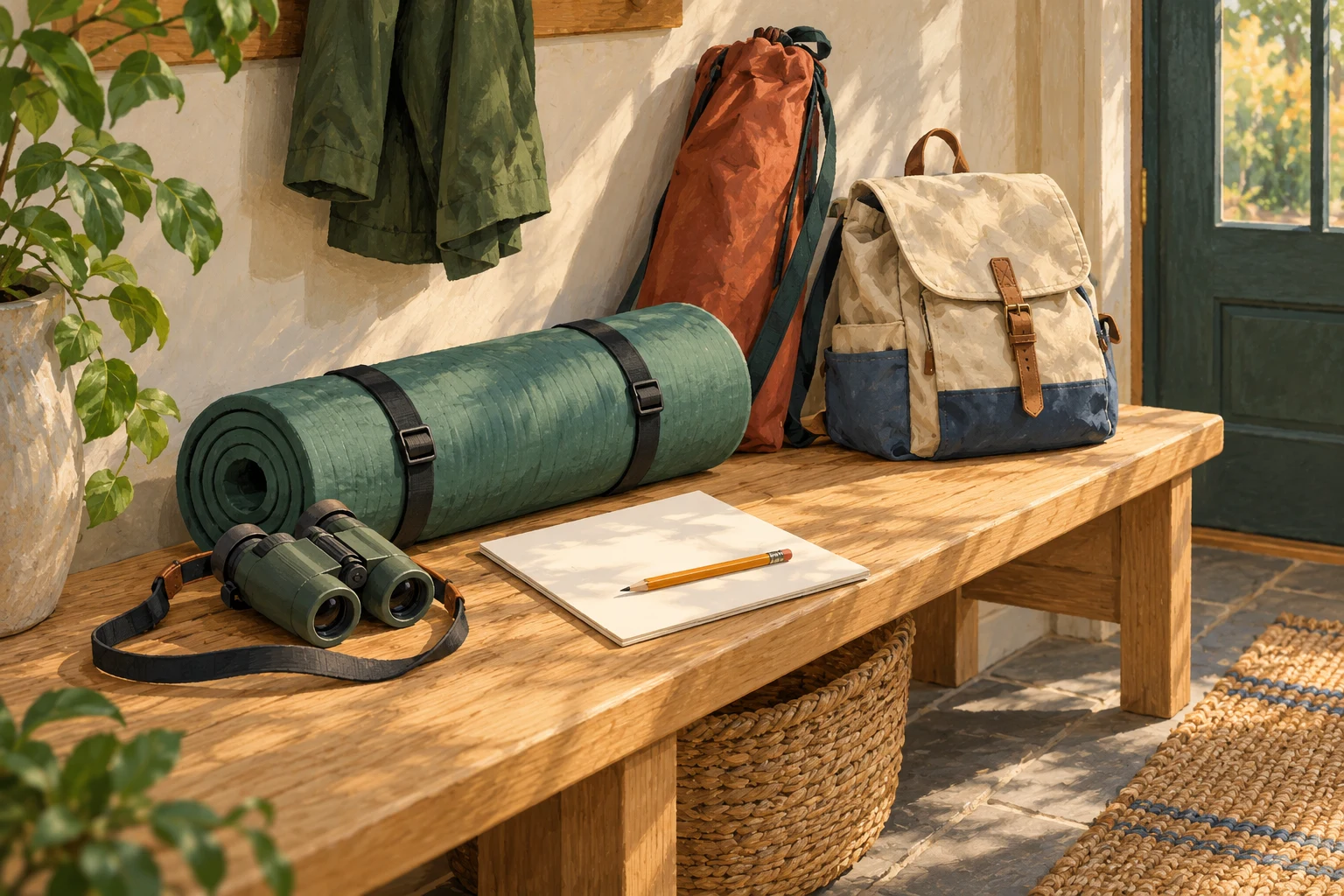
Start with a real occasion: a camping weekend already on the calendar, a first birdwatching walk, a family game night. Then compare three workable ways to equip it. Borrowing may let you try the activity with little commitment. Renting can provide a defined pickup and return arrangement. Buying gives you control over when the gear is available, along with responsibility for keeping it ready.
That distinction matters as outdoor participation expands. The Outdoor Industry Association’s 2026 participation summary reports 183.2 million participants, but says the average participant makes five fewer annual outings than in 2019. More people taking part does not mean every participant needs a cupboard full of equipment. Nor does that report establish that borrowing is growing; it simply gives us a good reason to examine occasional use.
Compare complete plans for the same outing
“Borrow a tent” is not yet a plan. You need to know whether it is available on your dates, which pieces come with it, how you will collect it and where it will dry before return. Apply that same level of detail to a purchase. A low price is less helpful if poles, a pump, transport fittings or a necessary accessory must be added.
Make a short equipment list for the activity, then put three columns beside it: included, already owned and still needed. Ask the lender or rental provider to identify the exact kit. This is especially useful when an advertised package sounds complete but you have not checked its contents or whether it suits the people using it.
| Route | When it is worth investigating | The question that can change the decision |
|---|---|---|
| Borrow | You are trying an activity or need something for an occasional, flexible date. | Can you reserve the exact item, and what happens if it is late, incomplete or damaged? |
| Rent | You want a defined period of use without storing the item afterward. | Does the charged period include collection and return, and what else is charged? |
| Buy | You value spontaneous access, know what fits, and have somewhere suitable to keep it. | Will the whole kit be ready to use when you need it, including maintenance and transport? |
Look for access before assuming you must buy
A library search can go beyond books. Boston Public Library’s Library of Things, for example, lists birdwatching kits and telescopes. Its rules require an eligible physical adult or teen MBLN card in good standing; the listed loan period is 14 days with no renewals, and items must return to the pickup branch’s desk. That is a useful local possibility, not a promise that your library offers the same equipment or has it available for your dates.
University recreation programs are another place to investigate. Portland State’s outdoor equipment rental program accepts public rentals at nonmember rates. Its base rental period covers one to four days and includes the collection and return days. Its instructions also make checking equipment before departure and returning it in the required condition part of the renter’s job. Read those details before comparing a rental quote with a purchase price.
Search your own library system, municipal recreation service and nearby outdoor centers. Check eligibility first, then dates and contents. A program that exists 40 miles away but closes before you finish work may be less useful than a more expensive option close to home. The cost calculator below deliberately leaves that judgment to you.
Work out the cost for the period you can realistically predict
Use one comparison period—perhaps the next 12 months—and count outings in that period. Enter the total rental or borrowing cost for one complete outing, including charged pickup or return days. If borrowing has no fee, enter zero, then add any travel or other cash costs that differ between the options. Include only differences: an expense you would pay either way cancels out.
For ownership, include the item, accessories needed only with that purchase, delivery, and maintenance or storage costs for the chosen period. Put costs that occur each time you use it in the per-outing field. If you expect to keep the equipment after the period, set resale to zero to compare cash spent during that period. A resale estimate is useful only as a separate scenario in which you actually sell it; it is not guaranteed income.
Borrow-or-buy cost calculator
Use one period, such as the next 12 months, and one currency throughout. Default values are hypothetical. Resale applies only if you sell within that period.
This tool adds no tracking and does not send or save your entries. It runs in your browser; the worked example remains readable without JavaScript.
The example is hypothetical. A $400 purchase, $40 in ownership extras and $5 per outing costs $470 across six outings, versus $240 for access at $40 per outing. Under those unchanged assumptions, buying first becomes cheaper on the thirteenth outing. Those are invented inputs to demonstrate the arithmetic, not prices for a particular product or a forecast of your use.
The calculation is: purchase plus ownership extras, minus assumed resale, plus outings multiplied by ownership cost per outing. The alternative is its fixed access fees plus outings multiplied by its cost per outing. The tool compares cash amounts in one consistent currency. It does not price your time, predict repairs, or account for financing, taxes or other costs you have not entered.
Try a pessimistic use count before committing
Run the calculation again with half the outings you first imagined. Then set resale to zero. If buying still appeals, the choice depends less on an optimistic calendar or a future buyer. If it stops making sense, that does not automatically rule it out: immediate availability may matter enough to justify the extra cost. At least you can now name what you are paying for.
For a new hobby, one rental or loan can answer questions that a specification sheet cannot. Can you carry the packed kit? Where do the wet pieces go afterward? Does the setup fit into the time you actually have? Keep notes after that first occasion, including anything that made you hesitate to use it. Those observations are more useful for the eventual purchase than a wish list written before trying the activity.
Fit should remain a separate test. A cheap route to equipment that does not suit you is not a saving. REI’s beginner backpacking guidance discusses borrowing or renting major equipment while emphasizing appropriate gear and fit. Check how borrowed equipment fits before making it the basis of your plans.
Count the space between outings
Write down where the item will live in three conditions: packed, in use and awaiting cleaning or drying. Then check the route between those places. A foldable boat may fit in a cupboard but still need a suitable place to dry; our foldable kayak guide explains why packed size, transport and setup belong in the same decision.
The same reasoning applies indoors. A game table that fits during a party may be inconvenient for the other six days of the week. Our shared-room table-tennis guide separates playing space from storage and changeover so you can test the whole routine.
Borrowing is a good first investigation when the activity or your schedule is uncertain. Renting deserves a close look when storage is the obstacle. Buying becomes more convincing when you know the equipment suits you, can keep it ready and expect to use it enough—or value spontaneous access enough—to justify its cost. Make the choice for the next real occasion, and revisit it when your habits change.
