
Table of Contents
Outdoor living · Researched September 30, 2026
A backyard can be pleasant after dark without being bright from fence to fence. The key is to decide what you need to see: a key at the back door, the edge of a step, the meal on a table. Each asks something different of a light.
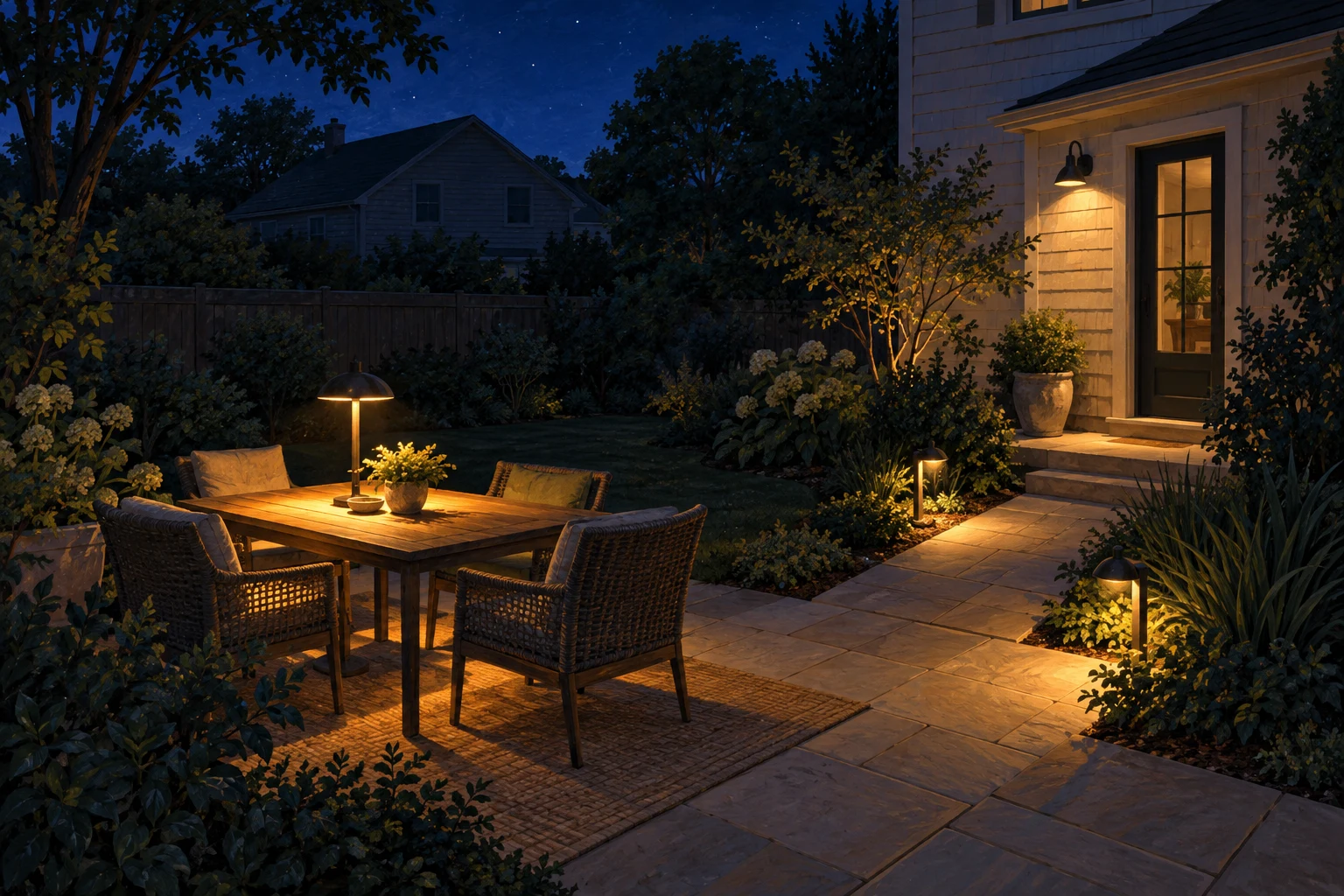
Begin with the evening you want to have, then work backward to the fixtures. A quiet seat outside and a route from the kitchen do not necessarily need the same light to be on. Treating them separately gives you more control than a single bright floodlight over the whole garden.
Give each light a job and an off time
DarkSky International and the Illuminating Engineering Society describe responsible lighting through five principles: it should serve a purpose, reach its intended target, use no more light than needed, be controlled and favor warmer colors. Their Five Principles guidance, with supporting graphics updated in September 2026, provides a useful starting point for a household plan. The principles are established guidance, not a new residential lighting law.
Take a sheet of paper and draw only the places you use after dark. Mark the door, walking route and sitting or dining area. Next to each, write a verb: unlock, walk, eat, read. If you cannot name a task for a proposed light, leave it out of the first plan and see whether you miss it.

| Place | What to observe | Control to consider |
|---|---|---|
| Back door | Can you see the lock and threshold without looking into the light source? | A switch or suitable sensor that provides light for arrival and departure. |
| Walking route | Are changes in level visible from both directions, including near corners? | A separate circuit or control so route lighting can be used when needed. |
| Dining or sitting area | Can people see the table comfortably from their actual seats? | A local light with a compatible dimmer or adjustable output. |
| Unused lawn or planting | Is there a reason to illuminate it tonight? | Leave it off unless a specific use calls for light. |
This is an observation plan, not an instruction to install four systems. Existing controls may already do the job. A portable lamp may suit a dining table, provided its manufacturer approves the location and conditions. Permanent wiring and changes to mains-powered fixtures belong with a qualified installer and applicable local requirements.
Read lumens, watts and color temperature separately
Lumens describe light output; watts describe power use. The US Department of Energy’s lumen explainer recommends comparing lumens when choosing brightness. Neither number tells you where a fixture sends the light. Two fixtures with similar output can produce very different experiences when one exposes a bright bulb at eye level and another directs its output onto the intended surface.
Color temperature, expressed in kelvin, describes the appearance of the light. Lower values generally look warmer. DarkSky’s residential guidance recommends 3000 K or below; around 2700 K is one warm option discussed in the National Park Service’s lighting guidance. These are useful selection cues, not proof that a bulb is appropriate for every location.
A warm lamp can still be too bright, badly aimed or left on unnecessarily. Likewise, a solar-powered fixture does not automatically control glare or keep light within your property. Read the output, beam direction, shielding and controls as separate parts of the specification. Power source alone does not answer those questions.
There is no single lumen number in this guide for a “safe backyard.” The area, mounting height, surface, obstacles and users all change what needs to be visible. Start with a controllable installation appropriate to the task, then assess it in place rather than buying the largest output available.
Judge the light from the seat and the boundary
A fixture can look attractive in a daytime product photograph and be uncomfortable from a chair underneath it. Check whether its light source will be visible from the positions people actually occupy. A shield can help direct light, but its effectiveness depends on the fixture’s orientation and placement. The National Park Service explains how shielding, careful aiming and appropriate output help limit glare and unwanted light in its outdoor-lighting principles.
Walk to the edge of your own property and look back toward the patio. Notice whether light reaches a neighbor’s window or crosses the boundary where it has no purpose. The NPS distinguishes this spill, often called light trespass, from broader skyglow in its explanation of light pollution sources. Pointing a fixture downward helps target it, but light reflected from the ground can still contribute to the surrounding brightness.
That is why a row of low lights is not automatically a better choice than one carefully placed source. Look at the combined effect. Pay particular attention to pale paving or a light-colored wall beside the beam: the surface is part of what you see after switching on.
Use an after-dark check before buying more fixtures
With the lights you already have, visit the space in its normal evening arrangement. Keep the lighting needed to move around safely. Change one optional setting at a time so you can tell which adjustment helped. Use this short record to guide the next decision.
| Observation | Write down |
|---|---|
| At the door | What is difficult to see? Does the source shine into your eyes when you approach? |
| Along the route | Which exact edge, turn or change in level needs attention? |
| From each seat | Is the table usable? Which lamp or reflection draws your eyes away from it? |
| At the boundary | Where does light leave the area it is meant to serve? |
| After everyone goes inside | Which lights still have a job, and which can switch off? |
Keep notes in words rather than treating a phone photograph as a measurement. Camera exposure can make the scene look different from the experience you are recording. “Glare from the wall light in the left chair” is a more actionable note than “the patio looks too bright.” It points toward placement, shielding or output rather than a whole new shopping list.
Buy for the missing function
Once the observation identifies a gap, compare fixtures that can address it. Look for an appropriate outdoor-use rating and the manufacturer’s installation instructions, a stated lumen output and color temperature, a view of the shielding, and clear information about dimmer or sensor compatibility. If those details are absent, ask for them before treating a styled photograph as evidence of performance.
You can browse Peach Frog’s outdoor-lighting collection with that list in hand. A collection listing is not a certification that every fixture follows DarkSky guidance; check the exact model. If you are still experimenting with how you use the space, the borrow, rent or buy guide can help you weigh occasional-use equipment before adding more permanent possessions.
A successful first change might be a better control, a lower setting or the removal of a light that serves no evening task. The aim is a backyard where you can do what you came outside to do, while leaving the rest of the night as undisturbed as practical.
